
You manage trading losses by deciding the size of every loss before you place the trade, setting hard limits on a bad day, and treating a run of losses as something to plan for. If you trade prop-firm challenges, there is one more step: you can pair each challenge trade with a smaller, opposite trade on your own broker account, so a failed challenge is a planned ending rather than a lost fee. That is what Arbitrer does for you. Trading involves risk of loss, and the money in your broker account is real and at risk.
A few terms first. A prop firm is a company that sells you a challenge: you pay a fee (around $500 for a $100,000 account) for the chance to trade the firm's money and, if you hit its targets, receive a funded account. A lot is the standard unit of trade size. A stop loss is an order that closes a trade at a set loss. Daily drawdown is the most a firm lets you lose in one day.
TL;DR
- Cap the loss on every trade before entering, usually as a small percentage of the account, and use a stop loss.
- Set a daily loss limit and a pause rule so one bad session does not become a bad week.
- Losing streaks are normal; review them with data, not emotion.
- In prop challenges most attempts fail, so the fee is the real loss to manage. A paired hedge on your own broker account is designed to earn the fee back plus a profit target when the challenge fails.
- Hedging has its own risks and every prop firm sets its own rules.
Table of Contents
- Decide the loss before you enter
- Use leverage limits as a floor, not a target
- Reward, ratio and the maths of being wrong
- Set a daily limit and a pause rule
- What to do right after a loss
- The real loss in prop challenges: the fee
- Paired trades: planning for the fail
- How the protection works in practice
- Setup in plain steps
- What customers' completed cycles looked like
- Pricing
- Our view
- Try it before you spend anything
- FAQ
- Sources
Decide the loss before you enter
The most useful habit in loss management is to know what you can lose before the trade exists. That means three numbers: risk per trade, stop distance and position size.
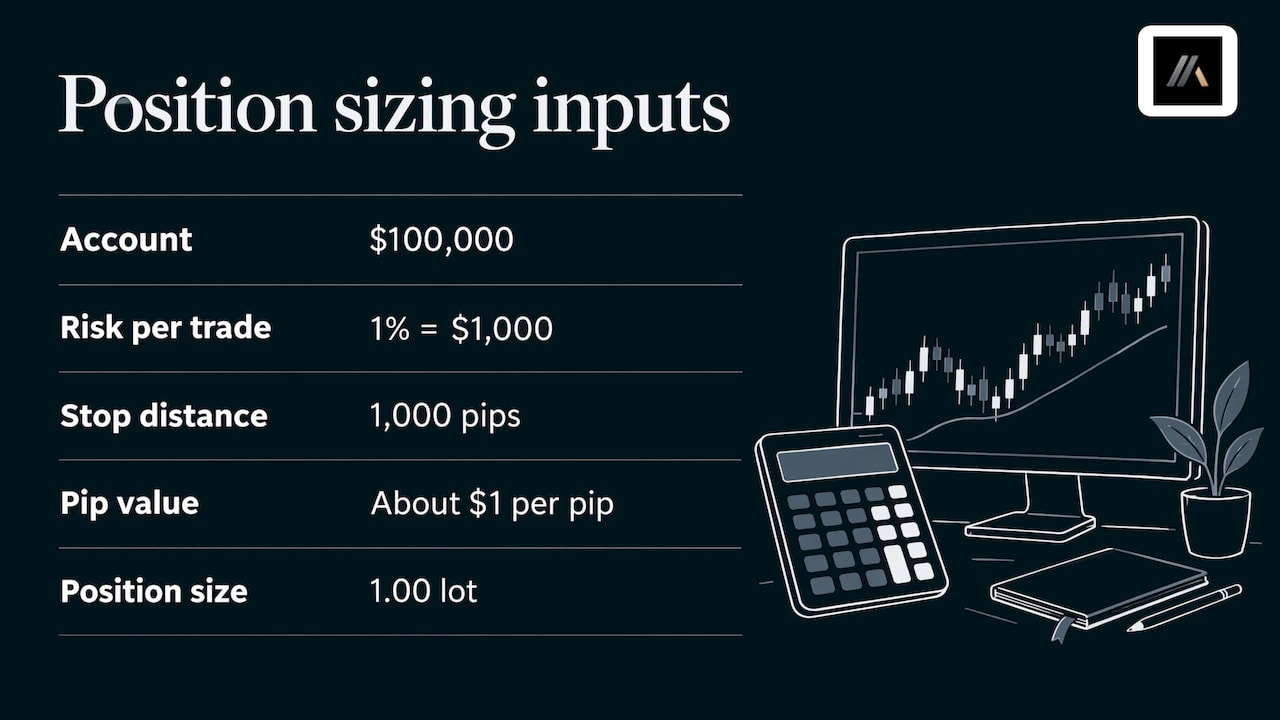
A common approach is to risk a fixed small percentage of the account on each trade. On a $100,000 account, 1% risk is $1,000. If your stop loss is 1,000 pips away, your trade size follows from that: 1.00 lot on a pair where each pip of a standard lot is worth about $1 gives a $1,000 loss if the stop is hit. The size is the output of the calculation, never a feeling.
A stop loss is not a perfect guarantee. The French regulator AMF has noted that a stop triggers a market order, which can fill at a different price in volatile markets, and that gaps such as the January 2015 Swiss franc event caused retail clients to lose more than they had invested. Plan for slippage, and keep size small enough that a bad fill is survivable.
Use leverage limits as a floor, not a target
Leverage lets you control a large position with a small deposit, which also magnifies losses. In the UK, the FCA's PS19/18 rules, effective 1 August 2019, cap retail leverage between 30:1 and 2:1 by asset class, require firms to close positions when funds fall to 50% of required margin, and provide negative balance protection. Those protections exist because high leverage hurts retail traders. Using less than your broker allows is the simplest way to reduce forex losses.
Reward, ratio and the maths of being wrong
You do not need to win most trades if your winners are larger than your losers. With a 1:3 reward-to-risk ratio, risking $1,000 to make $3,000, you break even on a quarter of trades before costs. Our guide to the risk reward ratio in forex shows how to read it. The point for loss management: a losing trade is information about variance, not proof your plan is broken.
Set a daily limit and a pause rule
Most large losses are a chain of small ones, each taken to win back the last. Two rules break the chain:
- A daily loss limit. Stop trading for the day once you have lost a fixed amount. Prop firms impose one for you; apply your own on a personal account. Our piece on the daily loss limit explains how it is usually measured.
- A pause after consecutive losses. After a set number of losers, step away and record what happened before the next entry.
Revenge trading, taking oversized or impulsive trades after a loss, is the pattern to design out. We cover it in avoiding revenge trading, and its close cousin in preventing overtrading.
What to do right after a loss
Pause, then write down the facts: instrument, size, entry, stop, exit, the reason for the trade and what you felt. Decide whether it was a plan loss (you followed the rules and the market disagreed) or a process loss (you broke a rule). Only process losses call for a change. Reviewing a week of entries together, rather than one trade, stops you tuning your plan to noise. A dashboard that tracks results for you helps; see what to track in prop challenges. If a streak is testing you, losing streak in trading covers what to expect.
The real loss in prop challenges: the fee
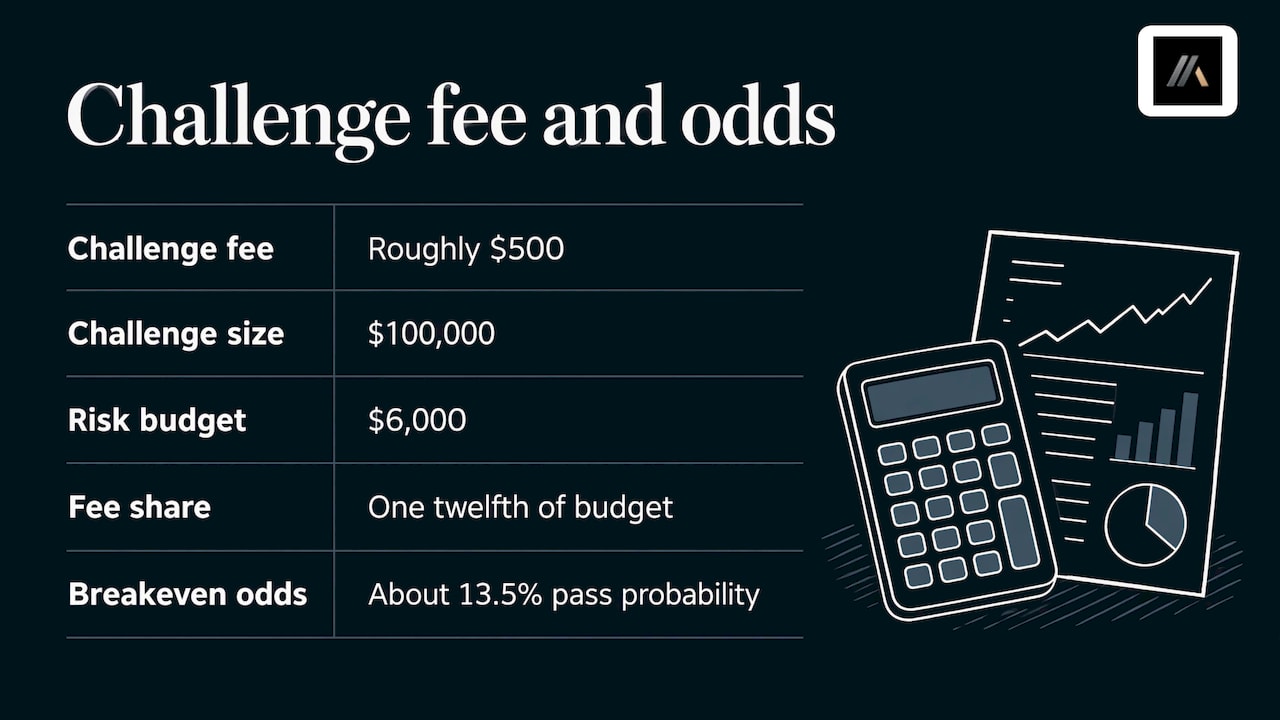
With a challenge, your risk is not only the trade but the fee. Analysis by Cantillon Research (August 2026) frames it as a sizing problem: a roughly $500 fee on a $100,000 challenge is one twelfth of a $6,000 risk budget, and where firms refund the fee at first payout, the breakeven pass probability is about 13.5%. In other words, the fee sets the odds you need.
Most challenges end in a fail. For many traders that is the painful part: fee after fee, with nothing back. If you run several challenges at once, the losses stack up and tracking them gets harder; see managing multiple trading accounts.
Paired trades: planning for the fail
We built Arbitrer around one idea: if most challenges fail, plan the fail. Every challenge trade is matched by a smaller, opposite trade on your own broker account. The opposite trade is sized so that if the challenge fails, the broker side earns back the challenge fee plus a profit target. If the challenge passes, the hedge's loss is carried into the next phase's target, and a funded account's payouts (80% split at the supported firms) are the upside. Most cycles end with the challenge failing, and that is the plan, not a setback. The full mechanics are in how a paired challenge trade works.
A worked example
Take a $100,000 challenge with a $500 fee, a $500 profit target, a 10% maximum loss, 1% risk per trade, a 1,000-pip stop and 1:3 reward.
| Prop account | Broker hedge | |
|---|---|---|
| Trade size | 1.00 lot | 0.12 lot |
| Losing trade | about -$1,000 | about +$108 |
| Winning trade | about +$3,000 | roughly -$360 |
The hedge is sized with a 0.90 capture ratio to allow for spread and slippage, later replaced by the pair's measured ratio. At the 10% maximum loss, the broker side holds about $1,080: the fee back plus the profit.
The Scenarios planner shows every ending and the broker capital a slot needs before the first trade.
Be honest about the risks
- Trading involves risk of loss, and the money in your broker account is real.
- If a challenge passes, the broker side is down until a later failed phase or a funded payout recovers it.
- If a passed account is then closed or a payout refused, the broker loss may not be recovered.
- Closing a cycle early by hand can lose money.
- Fills never match to the cent, because each provider sets its own prices and spreads.
Prop firm rules
Every prop firm sets its own rules, and we never claim a firm permits hedging. A firm that decides its rules were broken can refuse a payout, close the account or stop selling challenges. Arbitrer cannot change a firm's rules. We only enable well-known firms with a good payout record, we trade each firm to payouts ourselves, and we warn users and disable a firm that refuses payouts or bans users.
How the protection works in practice
Loss management is easier when the rules are enforced for you. In Arbitrer:
- Both legs open together, with a 0.11 s average gap between fills and 99.5% within 1 second.
- Every trade has a stop loss and take profit on both accounts from the moment it opens.
- If a stop or target closes one leg, Arbitrer closes the other.
- The daily-loss guard stops any trade whose stop would push today's loss past the firm's daily limit, and suggests trading smaller, tightening the stop or waiting for the reset.
- Both legs close 1 minute before high-impact news, and trading pauses until 5 minutes after.
- Both legs close 10 minutes before every daily and weekend market close.
- Alerts go out by WhatsApp first, then SMS, email and in-app.
Our guide to automated order management goes further.
Setup in plain steps
- You pick a prop firm and account size.
- You pick a broker.
- You enter two MetaTrader 5 logins (MetaTrader 5 is the trading platform both accounts run on) and press Launch.
Arbitrer rents a trading server (a VPS, a remote computer that stays on around the clock) for each slot, with its own fixed IP address used by no one else. It installs both MetaTrader 5 terminals, logs in and checks the right accounts, balances and terminals. It is usually ready in about 30 minutes and always within 12 hours. No trade can open until every check passes. Terminals are watched 24/7 and reconnected remotely if one goes offline. Logins are stored encrypted and deleted 7 days after a pair closes.
Supported prop firms are FTMO 2-Step, FundedNext Stellar 2-Step, Alpha Capital Group Alpha Pro 10%, BrightFunded 2-Step Classic and The5ers High Stakes Classic. Supported brokers are Vantage, VT Markets, PU Prime and Ultima Markets, with more added on request.
What customers' completed cycles looked like
These come from Arbitrer's November 2026 case study (production records on 2 November 2026, customers anonymised). Here, net means broker-side profit minus the challenge fee. The prop account balance is never counted as earnings.
- Trader A (Pro) went from 1 to 16 slots in 57 days, completed 29 cycles, all 29 in profit, and made $18,446 net after challenge fees. That averaged $754 per 200K cycle and a 5.5-day cycle, from 20 Aug to 31 Oct 2026.
- Trader B started on the Standard free month, closed the first cycle 3 days later at +$262, moved to Pro that day and has 3 cycles and $835.60 net.
These are completed cycles only, not typical of every user and not a guarantee.
Pricing
There is a limited-time offer of $100 off each slot's list price. See the pricing page for current terms. Signals alone are $19.99/month.
- Standard: $199/month (list $299) for 1 slot on 50K accounts, with the first month free and no card.
- Pro: $499/month per slot (list $599) for 50K, 100K and 200K accounts, with signals included.
- Multi-slot: $489 per slot per month for 2-9 slots and $479 from 10 slots, up to 20.
- Autopilot copy trading: $249 per slot per month ($199 on 2 or more slots).
Our view
Most advice on trading losses tells you to accept them and review them, and that is right. But in prop challenges the loss that hurts is the fee, paid again and again, and willpower does not fix it.
We think the better answer is structural. Size the opposite trade from the firm's own rules, open both legs together, and let stops, daily-loss limits and news protection run without anyone having to feel brave at the wrong moment. A failed challenge then becomes the expected ending, with the fee earned back plus a profit target, and a passed one carries its hedge loss forward with funded payouts as the upside.
None of this removes risk. The broker money is real, and the plan only works if you understand each ending before you start. That is why we put every ending in front of you first.
Marius
Try it before you spend anything
If you are tired of losing challenge fees, our free calculator at arbitrer.io shows what each ending pays and the broker capital it needs before you spend anything.

FAQ
How do I stop revenge trading after a loss?
Step away for a set time and write down what happened before the next entry. Use a daily loss limit so the day ends automatically once it is reached. Automated stops and guards remove the in-the-moment decision.
Is a 7 stop-loss rule a universal rule?
No. There is no single official rule by that name; traders use different loss caps. Choose a per-trade and per-day limit that suits your account size and any firm limits, and apply it consistently.
Does a stop loss guarantee my maximum loss?
No. A stop becomes a market order when triggered and can fill at a different price in fast markets, as the AMF notes. Keep size modest so a slipped fill does not hurt.
Can I lose money with paired trades?
Yes. Trading involves risk of loss and your broker money is real. If a challenge passes, the broker side is down until a later failed phase or funded payout recovers it, and closing a cycle early by hand can lose money.
Sources
- AMF decision of 1 August 2019 on CFDs
- FCA PS19/18: Restricting CFD products sold to retail clients
- Cantillon Research: the prop firm sizing problem
Recommended
- How to Avoid Revenge Trading in Prop Challenges
- Losing Streak in Trading: What to Do and Why Challenges Expect It
- Daily Loss Limit: How It Works and How to Stay Inside It
- How to Prevent Overtrading in Forex: Rules That Work
Trading involves risk of loss; only trade with money you can afford to lose. Results quoted come from Arbitrer's production records and individual customers' completed cycles and do not guarantee future results. Prop firm and broker names belong to their owners, who do not endorse Arbitrer, and each firm's own terms apply. This article is general information, not personal investment advice.