
Overtrading means taking more trades, or bigger trades, than your plan calls for. You prevent it by deciding your limits before the session starts and by making those limits hard to break: a fixed number of trades, a fixed daily loss and a fixed risk per trade. The most reliable version is one where software, not your mood, enforces the limits. That is how we build Arbitrer: every challenge trade is paired with a smaller opposite trade, opens with a stop loss and take profit already attached, and passes through a daily-loss guard before it is placed.
Trading involves risk of loss, and the money in your broker account is real and at risk. Nothing below removes that.
TL;DR
- Overtrading is a plan problem, not a trade-count problem: it is trading outside your own rules, often after a loss.
- Set three numbers before each session: maximum trades, maximum daily loss and risk per trade.
- Losses push traders to take more risk, so build a pause into the rules after a losing run.
- Review your journal for trades that broke the plan, not just trades that lost.
- In prop challenges, automated limits on both accounts take the impulse out of the decision.
Table of Contents
- What overtrading actually is
- What triggers it
- Set three limits before the session
- Make the limits hard to break
- Review your journal for rule breaks
- Why prop challenges raise the stakes
- Where the limits are enforced for you
- How setup works
- Perspective
- Try it on your own numbers
- FAQ
- Sources
What overtrading actually is
A few terms first. A forex trade is a bet on one currency rising or falling against another. A lot is the size of a trade: 1.00 lot on a pair like EUR/USD is 100,000 units of currency. A stop loss is an order that closes a trade automatically when it reaches a set loss. A prop firm is a company that sells you a challenge, a paid test of your trading on a simulated account, and may give you a funded account if you pass.
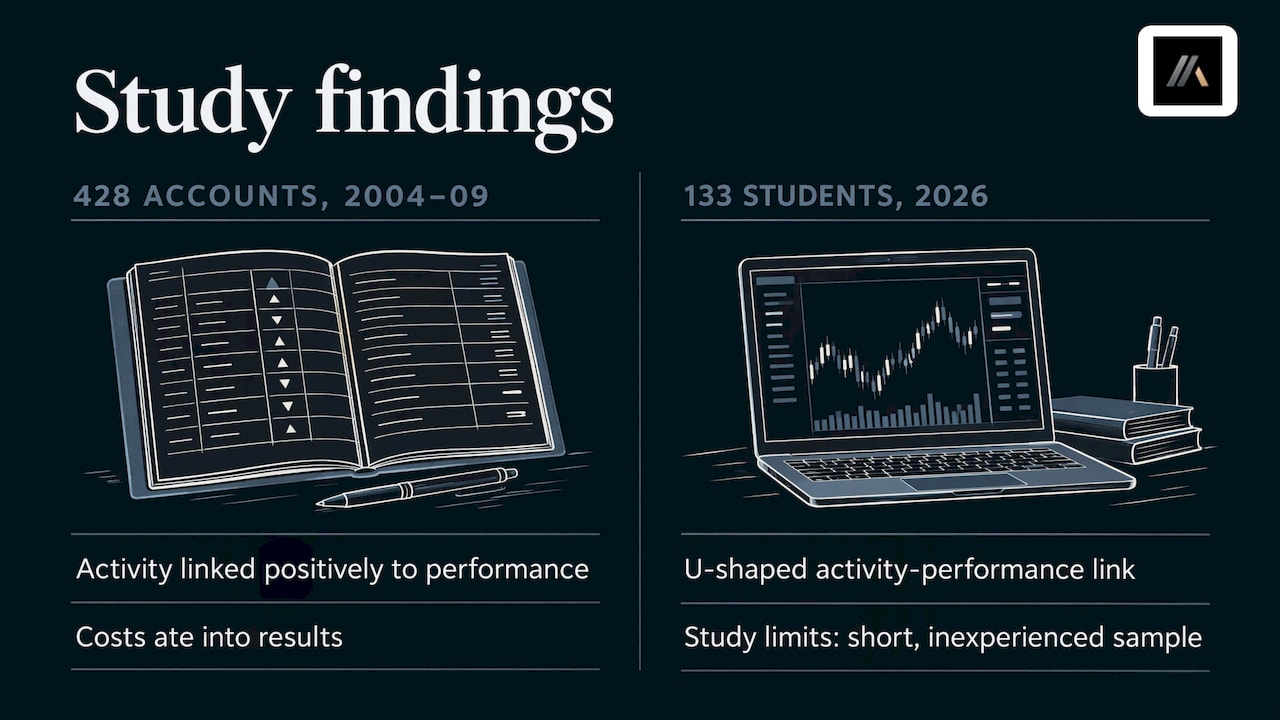
Overtrading takes two forms. You trade too often, or you trade too big. Neither is defined by a number. Research on the topic is more careful than most blog posts. A study of 428 retail forex accounts from 2004 to 2009 found that more trading activity was positively associated with performance in that sample, although costs ate into results. A 2026 simulation study of 133 students found a U-shaped link between activity and performance, though its authors caution that the short simulation and inexperienced sample limit what it says about real forex trading.
The practical reading: high frequency alone does not prove you are overtrading. The test is whether each trade meets the entry rules you wrote down before the session. A scalper placing thirty planned trades is following a plan. A swing trader placing four trades because the first two lost is not.
What triggers it
The most common trigger is a loss. In a well-known 2005 study in the Journal of Finance, proprietary futures traders who lost money in the morning were 31.2% likely to take above-average risk in the afternoon, against 27.0% after morning gains. The same study found losing traders were 17.4% more likely to place an above-average number of afternoon trades. That sample was professional traders at the Chicago Board of Trade, not retail forex, but the pattern will be familiar to anyone who has chased a loss.
Other common triggers:
- Boredom. Quiet sessions tempt you into setups that are not really there.
- A winning streak. Confidence pushes size up.
- A challenge deadline or a fee you want back. Pressure to recover money makes every candle look like an opportunity.
- Running several accounts. More screens means more chances to act on impulse and to lose track of total exposure. Our guide to managing multiple trading accounts without losing track covers that side.
If the revenge-trading pattern is your main problem, we go deeper in how to avoid revenge trading in prop challenges.
Set three limits before the session
Most advice reduces to this. Write down three numbers and treat them as the edge of the table.
- Maximum trades per day (or per hour). Pick a number that fits your strategy. If your plan finds two good setups a day on average, a cap of three or four stops the sixth trade of a bad afternoon.
- Maximum loss per day. Choose a figure you can absorb without changing your behaviour. When you hit it, you are finished until tomorrow.
- Risk per trade. A fixed percentage of the account, commonly 1%, so no single trade can do real damage.
Principles like these also appear in firms' own rule books. One prop firm's published guidelines, for example, include no more than two new trades per rolling hour, three open trades, 1% risk per trade and a one-hour break after two consecutive losses. Those are that firm's rules, not universal ones, and every prop firm sets its own. They show how a sensible limit set looks, including a forced pause after losses.
The risk-reward ratio belongs in the same plan. A trade that risks 1 to make 3 can lose more often than it wins and still work, which removes some of the urge to force trades. Our piece on the risk-reward ratio in forex shows how to read it.
Make the limits hard to break
A rule you can override in the moment is a suggestion. Three ways to harden it:
- Use orders, not intentions. Attach a stop loss and take profit when you open the trade, so you are not deciding mid-move. Our guide to automated order management explains how.
- Build a cooling-off rule. After two losses in a row, step away for a fixed time. Write it down, and set a phone alarm if you need to.
- Cap the day, not just the trade. A daily loss limit protects you from a string of acceptable losses adding up to an unacceptable one. See how a daily loss limit works.
Risk controls built for professional desks follow the same logic, moving from sizing to enforcement so that limits are checked automatically. Layered risk controls are a good model to borrow even if you trade alone.
And if you have just hit a losing run, remember it is part of trading, not proof of a broken plan: a losing streak is normal and challenges expect it.
Review your journal for rule breaks
A journal is only useful if it answers one question: did I follow the plan? For each trade, record the time, the size, the reason for entry and whether it matched your written setup. Then, weekly, sort the trades into two piles.
- Planned trades. Judge these by results over many trades, not one.
- Unplanned trades. Count them, and add up what they cost.
Signs you are overtrading show up quickly: unplanned trades cluster after losses, size creeps up after a win, and trades pile up in the last hour of a session. If the unplanned pile loses more than the planned pile earns, the fix is the rules above, not a new strategy. For which numbers to track, see forex trading analytics.
Why prop challenges raise the stakes
A challenge has a fee, a profit target and a daily and overall loss limit. Overtrading hurts twice: it can breach the limit and end the account, and it feeds the urge to win the fee back. Traders who run several challenges at once multiply the problem.
There is also a way to change the economics. Instead of trading the challenge and hoping, you can pair each challenge trade with a smaller, opposite trade on your own broker account. Arbitrer does this for you. In our worked example, a $100,000 challenge costs a $500 fee, with a $500 profit target, a 10% maximum loss, 1% risk per trade, a 1,000-pip stop and a 1:3 reward. The prop trade is 1.00 lot and the broker hedge is 0.12 lot, sized with a 0.90 capture ratio for spread and slippage (later replaced by the pair's measured ratio).
| Trade outcome | Prop account | Broker account |
|---|---|---|
| Losing trade | about -$1,000 | about +$108 |
| Winning trade | about +$3,000 | roughly -$360 |
At the 10% maximum loss, the broker side holds about $1,080: the fee back plus the profit. So if the challenge fails, the broker side has earned back the fee plus a profit target. Most cycles end with the challenge failing, and that is the plan, not a setback. If the challenge passes, the hedge's loss is carried into the next phase's target, and a funded account's payouts (an 80% split at the supported firms) are the upside.
Be clear about the risks. If a challenge passes, the broker side is down until a later failed phase or a funded payout recovers it. If a passed account is then closed or a payout refused, the broker loss may not be recovered. Closing a cycle early by hand can lose money. Our Scenarios planner shows every ending and the broker capital a slot needs before the first trade.
Where the limits are enforced for you
This is where overtrading prevention stops being willpower. On Arbitrer:
- Both legs open together, with a 0.11 s average gap between fills and 99.5% within 1 second. Fills never match to the cent, because each provider sets its own prices and spreads.
- Every trade gets a stop loss and take profit on both accounts from the moment it opens. If a stop or target closes one leg, Arbitrer closes the other.
- The daily-loss guard stops any trade whose stop would push today's loss past the firm's daily limit, and suggests trading smaller, tightening the stop or waiting for the reset.
- Both legs close 1 minute before high-impact news, and trading pauses until 5 minutes after.
- Both legs close 10 minutes before every daily and weekend market close.
- Alerts go out by WhatsApp first, then SMS, email and in-app.
For the mechanics, see automated trade execution and forex margin requirements.
A note on firm rules: every prop firm sets its own, and a firm that decides its rules were broken can refuse a payout, close the account or stop selling challenges. Arbitrer cannot change a firm's rules. We only enable well-known firms with a good payout record, we trade each firm to payouts ourselves, and we warn users and disable a firm that refuses payouts or bans users.
How setup works
You pick a prop firm and account size, then a broker, enter two MetaTrader 5 logins (MetaTrader is the trading platform most prop firms use) and press Launch. We rent a trading server (a VPS, a remote computer that stays on around the clock) for each slot, with its own fixed IP address used by no one else. We install both MetaTrader 5 terminals, log in and check the right accounts, balances and terminals. It is usually ready in about 30 minutes and always within 12 hours. No trade can open until every check passes. Terminals are watched 24/7 and reconnected remotely if one goes offline. Logins are stored encrypted and deleted 7 days after a pair closes.
Perspective
Most traders we talk to do not lack knowledge. They know they should stop after two losses. They lose discipline at the exact moment it matters, when the fee is gone and the next candle looks like the way back.
So we stopped treating overtrading as a character flaw and started treating it as a design problem. If the stop, the target, the daily limit and the news pause are all set before the trade exists, there is nothing left to argue with yourself about. And if every challenge trade is matched by a smaller opposite trade on your own broker account, a failed challenge is the expected ending rather than a disaster that tempts you to chase.
That is why we built it done for you. The limits are enforced whether you are calm or not. Trading still carries risk, and your broker money is real, but the decisions that cause overtrading are made once, in advance.
Marius
Try it on your own numbers
Standard is $199/month (list $299) for 1 slot on 50K accounts, with the first month free and no card. Pro is $499/month per slot (list $599) for 50K, 100K and 200K accounts, with signals included. Multi-slot is $489 per slot per month for 2-9 slots and $479 from 10 slots, up to 20. Autopilot copy trading is $249 per slot per month ($199 on 2 or more slots). Signals alone are $19.99/month. This is a limited-time offer of $100 off each slot's list price. See the full pricing.

Supported prop firms are FTMO 2-Step, FundedNext Stellar 2-Step, Alpha Capital Group Alpha Pro 10%, BrightFunded 2-Step Classic and The5ers High Stakes Classic. Supported brokers are Vantage, VT Markets, PU Prime and Ultima Markets, with more added on request.
The free calculator at arbitrer.io shows what each ending pays and the broker capital it needs before you spend anything.
FAQ
How do I stop overtrading in forex?
Set a maximum number of trades, a maximum daily loss and a fixed risk per trade before the session, then add a pause after consecutive losses. Attach stops and targets when you open each trade. The more of this that is automatic, the less it depends on mood.
Is trading a lot the same as overtrading?
No. Research on retail forex accounts shows no simple link between frequency and poor results. Overtrading means trading outside your written plan, whether that is thirty trades or three.
How do I know I am overtrading?
Review your journal. If unplanned trades cluster after losses, size grows after wins, or the unplanned pile costs more than the planned pile earns, your rules are not holding.
Can several prop challenges at once make overtrading worse?
They can, because exposure is harder to track and each loss invites a chase. Automated limits on every account, and a single view of all of them, keep the numbers visible.
Sources
- Decision Implementation Under Uncertainty: Trading Style (Sage Open, 2026)
- Do Currency Traders Make Money? (Abbey and Doukas)
- Do Behavioral Biases Affect Prices? (Coval and Shumway, 2005)
- Trading Rules | Prop Circle
- 5 Layer Prop Desk Risk Controls for Operators
Recommended
- How to Avoid Revenge Trading in Prop Challenges
- Automated Order Management for Forex Traders: A Practical Guide
- Losing Streak in Trading: What to Do and Why Challenges Expect It
Trading involves risk of loss; only trade with money you can afford to lose. Results quoted come from Arbitrer's production records and individual customers' completed cycles and do not guarantee future results. Prop firm and broker names belong to their owners, who do not endorse Arbitrer, and each firm's own terms apply. This article is general information, not personal investment advice.