
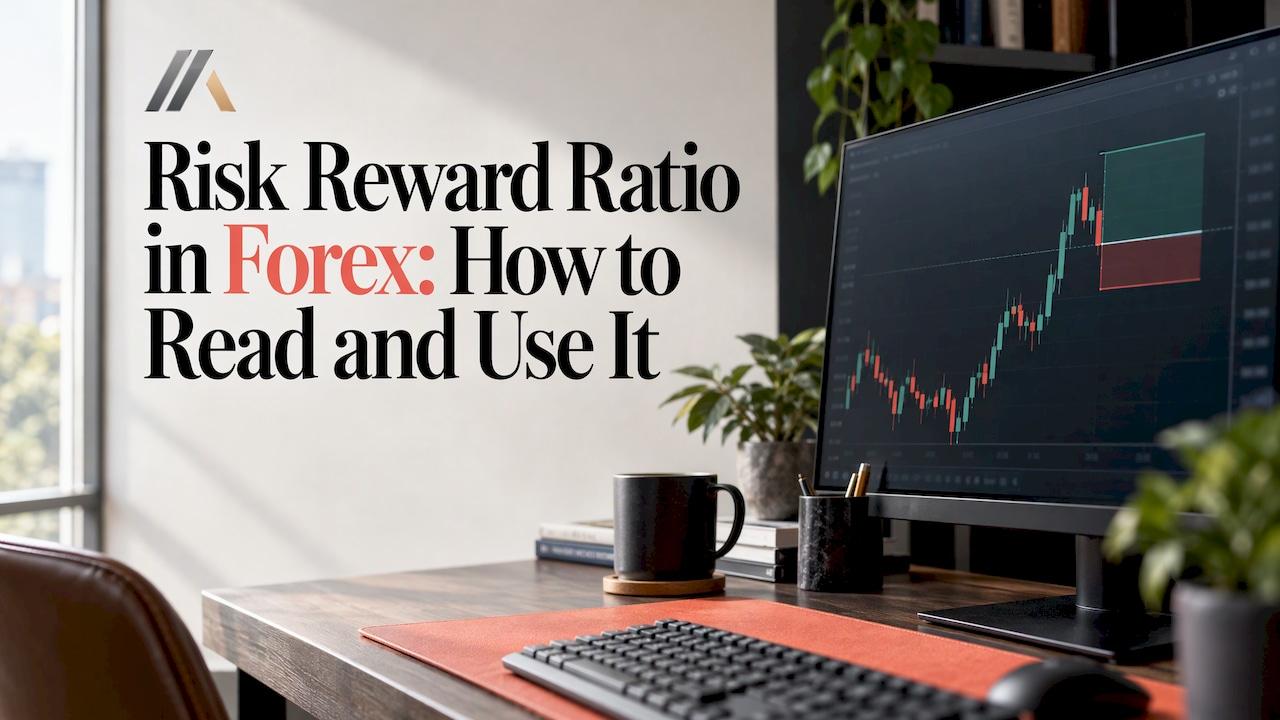
The risk reward ratio in forex compares what a trade can lose with what it aims to win. You set a stop loss (the price at which the trade closes automatically at a loss) and a take profit (the price at which it closes at a gain). The distance to each, measured from your entry, gives the ratio. A 20-pip stop and a 40-pip target is 1:2. A pip is the smallest standard price step in most currency pairs, usually the fourth decimal place.
The ratio is only half the picture. It tells you how often you must be right to break even, and in a prop-firm challenge it can be used for something more interesting: sizing a second trade that pays you back if the challenge fails. This guide covers both, in plain terms. Trading involves risk of loss, and the money in your broker account is real and at risk.
TL;DR
- Risk reward = distance from entry to take profit, divided by distance from entry to stop loss. Entry 1.0850, stop 1.0830, target 1.0890 gives 1:2.
- The break-even win rate is 1 ÷ (1 + reward), so 50% at 1:1, 33.3% at 1:2 and 25% at 1:3, before spreads and slippage.
- A good ratio does not make a strategy profitable on its own. Costs, missed fills and your real win rate decide the result.
- In a prop-firm challenge, we pair every challenge trade with a smaller, opposite trade on your own broker account. The ratio then works on two accounts at once.
- Most cycles end with the challenge failing, and that is the plan: the broker side is sized to earn back the fee plus a profit target.
Table of Contents
- What the ratio actually measures
- How to calculate it from entry, stop and target
- Ratio, win rate and break-even
- What a prop-firm challenge changes
- The ratio on two accounts: the hedged challenge
- Be honest about the risks
- Prop firm rules: what we can and cannot do
- Where the ratio breaks down: discipline and timing
- Our view
- Using Arbitrer to apply this
- FAQ
- Sources
What the ratio actually measures
Every trade has two numbers you choose before you click: how much you accept losing and how much you hope to make. The ratio puts them side by side.
- 1:1 means you risk £100 to try to win £100.
- 1:2 means you risk £100 to try to win £200.
- 1:3 means you risk £100 to try to win £300.
The first number is always the risk, so a bigger second number is a better payoff. Some writers flip it and quote "3:1" or "0.33". Check which side comes first before comparing figures from different sources.
Professional risk guidance tends to pair this with a small risk per trade. One 2025 academic review of professional risk management reports that professionals typically risk only 1 to 2% of the account on a trade, and use 1:2 as a common minimum benchmark so that a strategy can stay profitable even if only half of trades win. Its example: a $50,000 account risking 1% loses $500 on a failed trade.

How to calculate it from entry, stop and target
You need three prices: entry, stop loss and take profit.
- Risk = the distance between entry and stop loss.
- Reward = the distance between entry and take profit.
- Ratio = reward ÷ risk, written as 1:that number.
Example, buying EUR/USD at 1.0850:
| Item | Price | Distance from entry |
|---|---|---|
| Entry | 1.0850 | n/a |
| Stop loss | 1.0830 | 20 pips |
| Take profit | 1.0890 | 40 pips |
Reward 40 ÷ risk 20 = 2, so the trade is 1:2.
The ratio is in price distance, not money. To turn it into money you need position size, measured in lots. A lot is a standard trade size: one standard lot is 100,000 units of the base currency, and a 0.01 lot (a micro lot) is 1,000 units. The same 20-pip stop costs ten times more on 1.00 lot than on 0.10 lot. That is why traders fix the risk first (say 1% of the account), then work out the lot size that makes the stop distance equal that amount. Never the other way round.
Ratio, win rate and break-even
This is the part most beginners skip. The ratio and the win rate (the share of trades that hit the target) are linked.
Break-even win rate = 1 ÷ (1 + reward), where reward is the second number in 1:reward.
| Risk reward | Break-even win rate |
|---|---|
| 1:0.5 | 66.7% |
| 1:1 | 50% |
| 1:2 | 33.3% |
| 1:3 | 25% |
At 1:3 you can lose three trades out of four and still end level. That is why wide ratios are popular. But note what the table leaves out: it is before costs.
A higher ratio is not automatically better
Pushing the target further away lowers the chance price gets there. A 1:5 target that is hit 12% of the time is worse than a 1:2 target hit 40% of the time. The useful question is not "what ratio can I draw?" but "what ratio does this setup realistically deliver, and how often?" Keep a log of your last 50 to 100 trades and read your actual win rate before you trust any planned ratio.
Why the real ratio differs from the planned one
- Spread. You pay the gap between buy and sell prices on entry, so your real risk is slightly larger and your real reward slightly smaller.
- Slippage. In fast markets the fill can land away from the price you clicked.
- Stops moved or closed by hand. Trimming a winner early or widening a stop changes the ratio after the fact.
- Gaps. At market opens and around big news, price can jump past your stop.
So a planned 1:3 can become 1:2.7 on paper and worse in practice. Plan with a margin.
What a prop-firm challenge changes
A prop firm (proprietary trading firm) lets you trade its money after you pass a test. The test is a challenge: you pay a fee, around $500 for a $100,000 challenge, and try to hit a profit target without breaking loss limits. Pass all phases and you get a funded account, where you keep a share of the profits as payouts (80% at the firms we support).
Two loss limits matter most. The max loss is the total you can lose before the account is closed, often 10%. The daily drawdown is how far the account may fall within one day. Our guide to the daily loss limit shows how to stay inside it.
Here the ratio has a hard job. The firm's limits are fixed, so your stop size and risk per trade decide how many losing trades you can take before the challenge is over. Most traders lose the fee. Fees add up, especially when you run several challenges at once, and that is the problem our service is built around.

The ratio on two accounts: the hedged challenge
Our approach turns the ratio into a second line of defence. Every challenge trade is matched by a smaller, opposite trade on your own broker account. The opposite trade is sized so that if the challenge fails, the broker side has earned back the challenge fee plus a profit target. If the challenge passes, the hedge's loss is carried into the next phase's target. A funded account's payouts (80% split at the supported firms) are the upside.
Here is our worked example. All figures are from the planner, not from your account:
| Setting | Value |
|---|---|
| Challenge size | $100,000 |
| Challenge fee | $500 |
| Broker profit target | $500 |
| Max loss | 10% |
| Risk per trade | 1% |
| Stop | 1,000 pips |
| Reward | 1:3 |
| Prop trade | 1.00 lot |
| Broker hedge | 0.12 lot |
The hedge is sized with a 0.90 capture ratio. That is a built-in allowance for spread and slippage, later replaced by the pair's measured ratio. In practice:
| Outcome of one trade | Prop account | Broker account |
|---|---|---|
| Loses (stop hit) | about -$1,000 | about +$108 |
| Wins (1:3 target hit) | about +$3,000 | roughly -$360 |
Risking 1% of $100,000 is $1,000 per losing trade. Ten losing trades reach the 10% max loss of $10,000, the point where the challenge fails. By then the broker side holds about $1,080: the $500 fee back plus the profit target, with the sizing built to cover the allowance for costs.
The 1:3 ratio does the work on both sides. On the prop account a win is three times a loss, so the challenge can pass with a modest win rate. On the broker account the small opposite trade gains when the prop trade loses and gives back a smaller amount when it wins.
What the planner shows
The Scenarios planner shows every ending and the broker capital a slot needs before the first trade. That last number matters: the hedge needs real margin on the broker account, and our guide to forex margin requirements explains how margin works.
Be honest about the risks
The hedge is a plan, not a shield, and the money in your broker account is real. Trading involves risk of loss. Specifically:
- If a challenge passes, the broker side is down until a later failed phase or a funded payout recovers it.
- If a passed account is then closed or a payout refused, the broker loss may not be recovered.
- Closing a cycle early by hand can lose money, because you break the sizing that makes the two sides balance.
- Fills never match to the cent. Each provider sets its own prices and spreads, so the two sides will differ slightly.
Most cycles end with the challenge failing, and that is the plan, not a setback. You are not hoping to pass every time. The fee is covered by the broker side and the occasional passed account provides the upside.
Prop firm rules: what we can and cannot do
Every prop firm sets its own rules. A firm that decides its rules were broken can refuse a payout, close the account or stop selling challenges. We cannot change a firm's rules, and we do not claim any firm permits hedging: read each firm's current terms yourself before you buy.
What we do is enable only well-known firms with a good payout record. We trade each firm to payouts ourselves. If a firm refuses payouts or bans users, we warn users and disable that firm. The firms supported today are FTMO 2-Step, FundedNext Stellar 2-Step, Alpha Capital Group Alpha Pro 10%, BrightFunded 2-Step Classic and The5ers High Stakes Classic. The supported brokers are Vantage, VT Markets, PU Prime and Ultima Markets, with more added on request. Some firms also apply a consistency rule; see our guide to the prop firm consistency rule.
Where the ratio breaks down: discipline and timing
A planned 1:3 is only worth anything if both legs follow the plan. The usual failures are human. After a loss, a trader widens the next stop or doubles the size to win it back. Our piece on how to avoid revenge trading covers it. Timing matters as much: a stop placed over a news spike can be skipped by price.
That is why automation helps. Our guide to automated order management covers the principle, and in our service the rules are built in:
- Both legs open together, with a 0.11 s average gap between fills and 99.5% within 1 second.
- Every trade gets a stop loss and take profit on both accounts from the moment it opens.
- If a stop or target closes one leg, we close the other.
- The daily-loss guard stops any trade whose stop would push today's loss past the firm's daily limit, and suggests trading smaller, tightening the stop or waiting for the reset.
- Both legs close 1 minute before high-impact news, and trading pauses until 5 minutes after.
- Both legs close 10 minutes before every daily and weekend market close.
- Alerts go out by WhatsApp first, then SMS, email and in-app.
The trade runs on a MetaTrader 5 terminal, the widely used trading platform, hosted on a VPS (a rented remote server that stays online around the clock). To see the full flow, read how Arbitrer works, or our guide to linking broker and prop accounts. For watching open pairs, see trade monitoring.
Our view
Traders usually ask us what ratio to use. We think that is the second question. The first is: what happens to my money in each ending of the challenge?
A 1:3 ratio is attractive on a chart. But a challenge has a fee, a max loss and a daily limit, and a ratio that ignores them is half a plan. We built our service around writing every ending down in advance: fail, pass, funded, payout. The broker side is sized from the firm's own rules, so the fee is covered when the challenge fails, which is how most cycles end.
We would rather tell you plainly that a passed challenge leaves the broker side down until a later phase or payout recovers it than hide it. You can then decide with the real numbers, and plan the broker capital before spending a penny.
Marius
Using Arbitrer to apply this
If you want the ratio, the sizing and the protection handled for you, a slot is one challenge paired with one broker account. Prices are on our pricing page, and there is currently a limited-time offer of $100 off each slot's list price.
- Standard: $199/month (list $299) for 1 slot on 50K accounts, with the first month free and no card.
- Pro: $499/month per slot (list $599) for 50K, 100K and 200K accounts, with signals included.
- Multi-slot: $489 per slot per month for 2-9 slots and $479 from 10 slots, up to 20.
- Autopilot copy trading: $249 per slot per month ($199 on 2 or more slots).
- Signals alone: $19.99/month.

If you would like to see your own numbers first, try the free calculator at arbitrer.io. It shows what each ending pays and the broker capital it needs before spending anything.
FAQ
What does a 1:2 risk reward ratio mean in forex?
It means the distance to your take profit is twice the distance to your stop loss. Risking 30 pips to aim for 60 is 1:2. You need to win about one trade in three to break even, before costs.
What is a good risk reward ratio in forex?
Many professionals use 1:2 as a minimum benchmark, according to the 2025 review above, but no ratio is good on its own. What matters is the ratio together with your measured win rate and trading costs. A 1:3 setup that rarely reaches its target can do worse than a 1:1.5 one that often does.
How do I calculate my risk reward ratio?
Subtract your stop-loss price from your entry to get the risk in pips, subtract your entry from your take-profit price to get the reward, then divide reward by risk. If the answer is 3, the ratio is 1:3. Then size your lot so the stop equals your chosen risk, commonly 1% of the account.
Does the ratio change in a prop challenge?
The maths is the same, but your risk is bounded by the firm's max loss and daily drawdown, and the fee is an extra cost. We pair each challenge trade with a smaller, opposite broker trade so that a failed challenge earns back the fee plus a profit target. Trading involves risk of loss, and the broker money is real. You can check the figures in our free calculator at arbitrer.io before you spend anything.
Sources
Recommended
- Forex Margin Requirements: How They Work and How to Manage Them
- Daily Loss Limit: How It Works and How to Stay Inside It
- How to Avoid Revenge Trading in Prop Challenges
- Automated Order Management for Forex Traders: A Practical Guide
Trading involves risk of loss; only trade with money you can afford to lose. Results quoted come from Arbitrer's production records and individual customers' completed cycles and do not guarantee future results. Prop firm and broker names belong to their owners, who do not endorse Arbitrer, and each firm's own terms apply. This article is general information, not personal investment advice.