
Leverage lets you control a trade many times larger than the money you put up, and gains and losses are both calculated on the full size of the trade. The risk is therefore set by the size of the position you take relative to your account, not by the leverage figure your broker advertises. Trading involves risk of loss, and the money in your broker account is real and at risk. If you trade prop-firm challenges, where a firm sets a loss limit on a simulated account, the same logic applies, and sizing is where we put most of our attention at Arbitrer.
TL;DR
- Leverage is borrowed exposure: a small deposit (margin) supports a much larger position, and profit and loss are measured on the whole position.
- Higher available leverage does not by itself mean higher risk. Risk comes from the lot size you choose and where your stop loss sits.
- Regulators cap retail leverage in some markets and require close-out rules, but a stop loss can still fill at a worse price in fast markets.
- In a prop challenge, a smaller opposite trade on your own broker account is sized so that, if the challenge fails, the broker side earns back the fee plus a profit target. Most cycles end that way, and that is the plan.
Table of Contents
- What forex leverage is, in plain words
- How leverage magnifies gains and losses
- Does higher leverage always mean higher risk?
- What the evidence says about retail results
- Leverage limits and protections by market
- How to keep leverage risk under control
- Leverage inside a prop challenge
- Perspective
- Run the numbers before you spend anything
- FAQ
- Sources
What forex leverage is, in plain words
Forex is the market for swapping one currency for another. Most retail traders do not buy actual currency: they open a contract with a broker that follows the price. To open it, they put down a deposit called margin, and the broker lends the rest of the exposure.
Leverage is the reciprocal of the margin requirement. OANDA explains that a 5% margin requirement equals 20:1 leverage, and that margin used is the position size multiplied by the margin rate: 10,000 EUR at 5% needs 500 EUR. Charles Schwab's 2025 guide says margin on major pairs such as EUR/USD is typically 2% to 5% of the position's value, and that a 3% requirement gives roughly 33:1.
A few terms you will meet throughout:
- Lot: the unit of trade size. One standard lot is 100,000 units of the base currency.
- Pip: the usual smallest price move quoted in a currency pair.
- Stop loss: an order that closes your trade if price moves a set distance against you.
- Take profit: an order that closes your trade once it reaches a set gain.
- Margin call / close-out: the broker asks for more funds, or closes your positions automatically, when your equity falls too low against the margin required.
For a deeper look at the mechanics, our guide to forex margin requirements walks through the calculation.
How leverage magnifies gains and losses
Schwab's worked example uses a standard EUR/USD lot with about $3,300 of margin. A 100-pip move, which is just under 1% of the price, is worth $1,000 either way. A further 65-pip fall in the wrong direction leaves only half of the initial margin, and the position is closed automatically if there is no extra equity in the account (Charles Schwab, 2025).
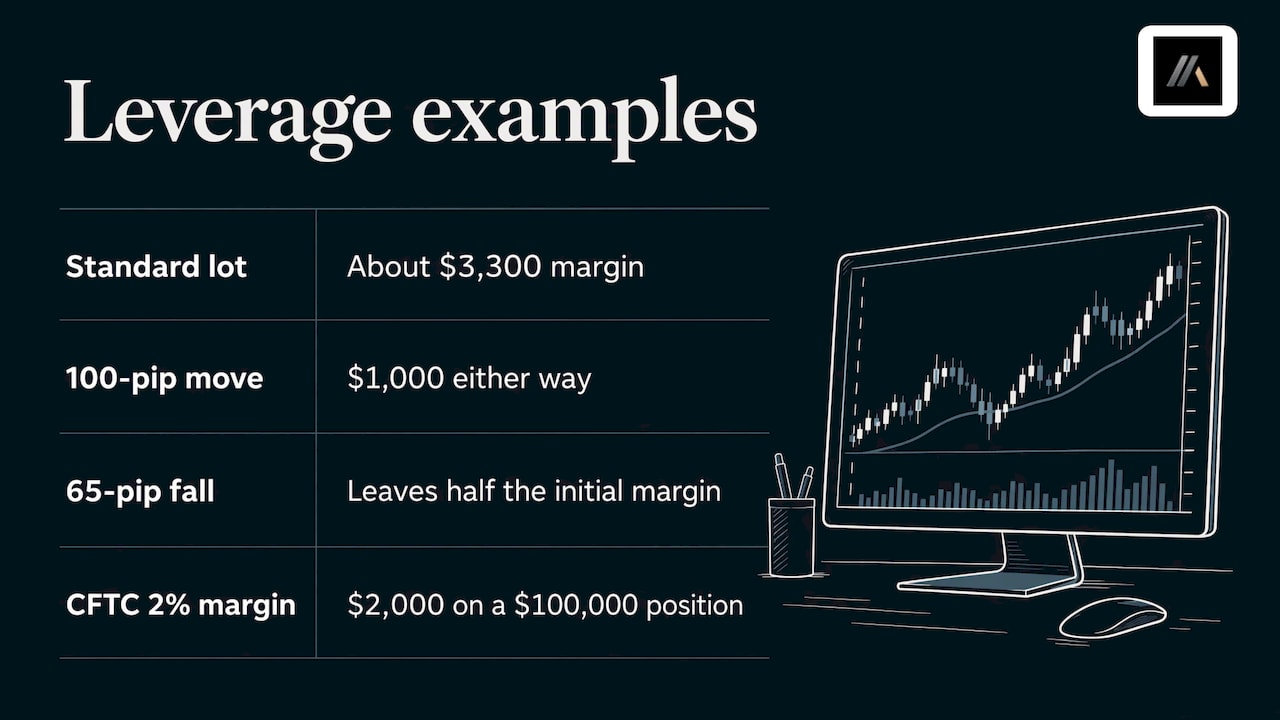
That is the whole mechanism. A move that looks tiny on a chart is large relative to the deposit behind it. The US CFTC's customer advisory puts it this way: with a 2% margin requirement you can open a $100,000 position with $2,000, and the same leverage that amplifies gains amplifies losses. It adds that, depending on the dealer, a trader may be liable for losses beyond the initial deposit (CFTC customer advisory).
The New Zealand Financial Markets Authority describes margin trading as like borrowing money to place a bet: you pay a small part up-front but are responsible for the full amount plus losses.
Does higher leverage always mean higher risk?
Not automatically, and this is the point most beginner guides blur.
Imagine two traders with $10,000. Both decide to risk 1% of the account, $100, on a trade with a stop loss 50 pips away. They will both open roughly the same position size, whether their broker offers 30:1 or 500:1. The only difference is how much margin each one has locked up. Now imagine a third trader who, because 500:1 is available, opens a position ten times larger with the same stop. That trader risks $1,000, or 10% of the account, on one idea.
So higher available leverage raises the ceiling on what you can do wrong. It lifts your actual risk only when you use it. Three things decide the real exposure:
- Position size relative to equity. The larger the share of your funds committed, the greater the risk, as OANDA's guide notes.
- Stop distance. A wider stop at the same lot size risks more money.
- How many positions are open together. Several trades on correlated pairs can behave like one large trade.
High leverage also shortens your margin of error. The Central Bank of Ireland notes that high leverage raises the probability that a position is closed automatically or that the client must post more margin.
What the evidence says about retail results
You will often read that 90% of forex traders lose. The figure varies by source and period, so treat it as a rough warning rather than a statistic. A regulator figure you can check: the CFTC reports that over the past year about one-third of customers at registered US forex dealers made a profit, and two-thirds lost money once fees, financing charges and other expenses were counted (CFTC).
Australia's Moneysmart, run with ASIC, lists further risks: prices can swing sharply over short periods, spreads and financing costs add up, a stop loss offers limited protection, and delays in execution can occur (Moneysmart, updated 10 September 2026).
Leverage limits and protections by market
Rules differ by country, so check the one your broker is regulated under.
| Market | Rule | Source |
|---|---|---|
| EU (ESMA, 2018) | Retail CFD leverage of 30:1 on major currency pairs, 20:1 on non-major pairs, gold and major indices; 50% margin close-out; negative balance protection | ESMA FAQ via MNB |
| Ireland (from 1 August 2019) | 3.33% initial margin (30:1) on major pairs, 5% (20:1) on others; close-out; negative balance protection | Central Bank of Ireland |
| Nigeria (proposed rules) | Up to 1:400 on major pairs; close-out at 50% of required margin; negative balances restored to zero | Nigeria SEC |
Negative balance protection means a retail client cannot lose more than the sum in the account. ESMA introduced it after the January 2015 euro–Swiss franc crash, when some retail investors without it owed providers very large sums. Where it is not in force, the CFTC warns you may owe more than you deposited.
A stop loss is not a perfect shield either. The Central Bank of Ireland points out that a stop only triggers a market order, so the fill price can differ, and New Zealand's FMA warns that stops may fail entirely in extreme market movements (FMA).
How to keep leverage risk under control
These habits apply to any leveraged account:
- Fix a risk per trade. Many traders choose 1% of equity or less, and calculate the lot size from the stop distance, not the other way round.
- Set the stop before you enter. Know the money you lose if it is hit.
- Check the reward against the risk. Our guide to the risk reward ratio in forex shows how a 1:3 target changes the maths of a losing streak.
- Watch your daily limit. If you trade a prop account, understand how a daily loss limit works and how it differs from the overall limit in prop firm drawdown rules.
- Understand what is measured. Balance versus equity drawdown decides when a floating loss counts against you.
- Be ready for the run of losses. Even sound sizing meets losing streaks.
If you want a plain primer from a different angle, this practical guide to leverage in 2026 covers how leverage raises potential losses.
Leverage inside a prop challenge
A prop firm is a company that sells you a challenge: you pay a fee, trade a simulated account to a profit target without breaching its loss limits, and if you pass you may get a funded account with payouts. The fee is typically around $500 for a $100,000 challenge. Leverage matters here because the firm's loss limits, not your broker's margin call, are what end your attempt.
Most challenges fail. That is why the fee is the real cost of the attempt. Our approach is to treat that as the plan and size around it.
Every prop-challenge trade is matched by a smaller, opposite trade on your own broker account. The opposite trade is sized so that, if the challenge fails, the broker side earns back the challenge fee plus a profit target. If the challenge passes, the hedge's loss is carried into the next phase's target, and a funded account's payouts (80% split at the supported firms) are the upside.
Here is the worked example we use, with a $100,000 challenge, a $500 fee, a $500 profit target, a 10% maximum loss, 1% risk per trade, a 1,000-pip stop and a 1:3 reward:
| Prop account | Broker account | |
|---|---|---|
| Trade size | 1.00 lot | 0.12 lot |
| Losing trade | about -$1,000 | about +$108 |
| Winning trade | about +$3,000 | roughly -$360 |
The hedge is sized with a 0.90 capture ratio to allow for spread and slippage, later replaced by the pair's measured ratio. Run the losing trade ten times to reach the 10% maximum loss, and the broker side holds about $1,080: the fee back plus the profit.
The risks are real, and we state them plainly:
- Trading involves risk of loss, and the money in the broker account is real.
- If a challenge passes, the broker side is down until a later failed phase or a funded payout recovers it.
- If a passed account is then closed or a payout refused, the broker loss may not be recovered.
- Closing a cycle early by hand can lose money.
- Fills never match to the cent, because each provider sets its own prices and spreads.
Firm rules. Every prop firm sets its own rules, and a firm that decides its rules were broken can refuse a payout, close the account or stop selling challenges. Arbitrer cannot change a firm's rules. We only enable well-known firms with a good payout record, we trade each firm to payouts ourselves, and we warn users and disable a firm that refuses payouts or bans users.
Perspective
Leverage is not the danger people think it is. Unplanned size is. A trader who picks a lot size from a fixed risk figure and a stop distance has bounded the loss before the trade opens. A trader who picks it by feel has not.
That is why we built Arbitrer around sizing. The hedge is calculated from each firm's own rules, both legs open together with a 0.11 s average gap between fills (99.5% within 1 second), and every trade carries a stop loss and take profit on both accounts from the moment it opens. A daily-loss guard stops any trade whose stop would push today's loss past the firm's limit, and both legs close 1 minute before high-impact news and 10 minutes before each daily and weekend market close.
The Scenarios planner shows every ending and the broker capital a slot needs before the first trade. We would rather you see the numbers first.
Marius
Run the numbers before you spend anything
We built the sizing, the servers and the protection so you do not have to do the arithmetic by hand on every trade. You pick a prop firm and account size, pick a broker, enter two MetaTrader 5 logins (the trading platform most prop firms use) and press Launch. We rent a trading server (a VPS, a remote computer that runs around the clock) for each slot, with its own fixed IP address used by no one else, install both terminals, log in and check the accounts, balances and terminals. It is usually ready in about 30 minutes and always within 12 hours, and no trade can open until every check passes. Terminals are watched 24/7 and reconnected remotely if one goes offline, and alerts go out by WhatsApp first, then SMS, email and in-app. Logins are stored encrypted and deleted 7 days after a pair closes.
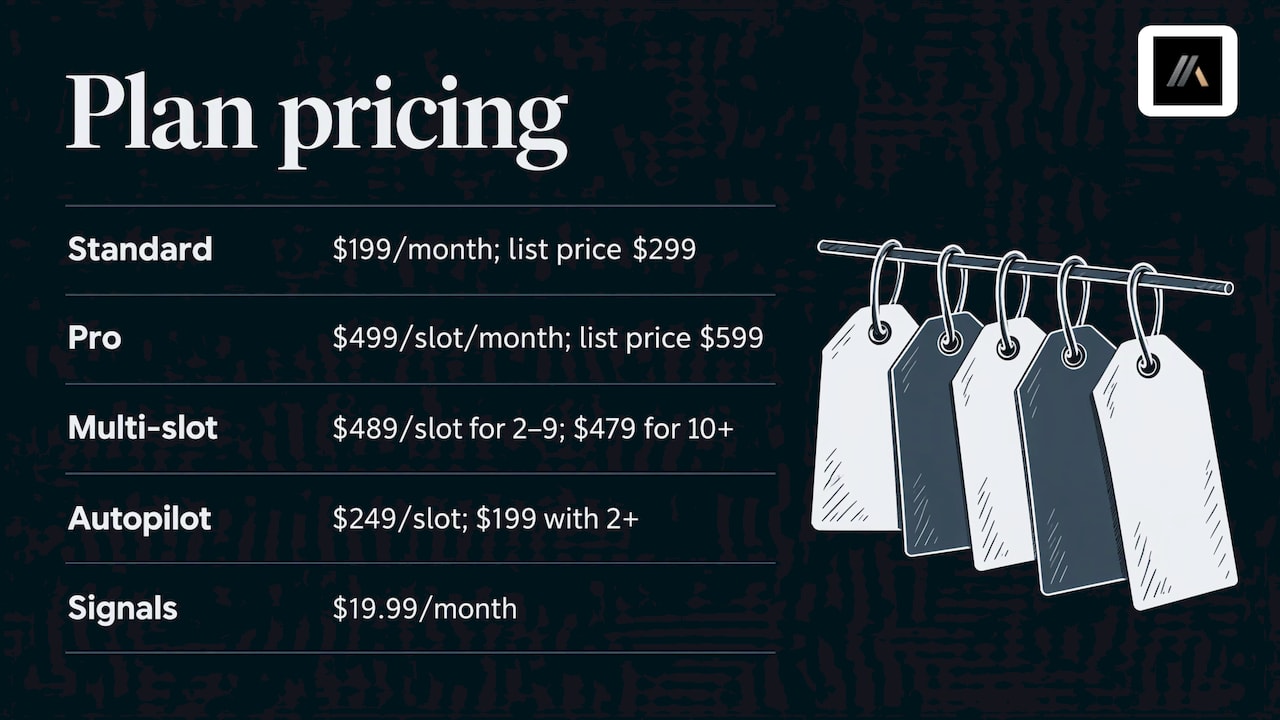
On pricing, a limited-time offer takes $100 off each slot's list price. Standard is $199/month (list $299) for 1 slot on 50K accounts, with the first month free and no card. Pro is $499/month per slot (list $599) for 50K, 100K and 200K accounts, with signals included. Multi-slot is $489 per slot per month for 2-9 slots and $479 from 10 slots, up to 20. Autopilot copy trading is $249 per slot per month ($199 on 2 or more slots), and Signals alone are $19.99/month.

Supported prop firms are FTMO 2-Step, FundedNext Stellar 2-Step, Alpha Capital Group Alpha Pro 10%, BrightFunded 2-Step Classic and The5ers High Stakes Classic. Supported brokers are Vantage, VT Markets, PU Prime and Ultima Markets, with more added on request.
Try the free calculator at arbitrer.io. It shows what each ending pays and the broker capital it needs before you spend anything.
FAQ
How much leverage is there in forex?
It depends on the broker's regulator. Retail limits for major pairs are 30:1 in the EU and Ireland, while some markets allow far more, such as the 1:400 proposed in Nigeria. Always check the limit your own broker applies.
Is higher leverage higher risk?
Higher leverage lets you open a larger position on the same deposit, so it raises the maximum loss you can take. Your actual risk is set by lot size and stop distance, so a small position on high leverage can be less risky than a large one on low leverage.
Can I lose more than I deposit?
In the EU and Ireland, negative balance protection means a retail client cannot lose more than the account holds. Elsewhere, the CFTC warns a trader may be liable for more than the initial deposit, so read your broker's terms.
What is the 90% rule in forex?
It is a popular claim that about nine in ten retail traders lose money. The figure varies by source and period. The CFTC reports about two-thirds of customers at registered dealers lost money over one year, after costs.
Sources
- Understanding margin and leverage, OANDA
- Understanding Forex Margin, Charles Schwab
- Customer Advisory: Eight Things You Should Know Before Trading Forex, CFTC
- Forex trading, Moneysmart
- Foreign exchange trading, Financial Markets Authority
- Central Bank CFD Intervention Measure, Central Bank of Ireland
- ESMA product intervention FAQ, via MNB
- Proposed rules on online forex and CFD trading, Nigeria SEC
- The Role of Leverage in Trading: A 2026 Guide
Recommended
- Risk Reward Ratio in Forex: How to Read and Use It
- Forex Margin Requirements: How They Work and How to Manage Them
- Daily Loss Limit: How It Works and How to Stay Inside It
- Balance vs Equity Drawdown: What Prop Firms Measure
Trading involves risk of loss; only trade with money you can afford to lose. Results quoted come from Arbitrer's production records and individual customers' completed cycles and do not guarantee future results. Prop firm and broker names belong to their owners, who do not endorse Arbitrer, and each firm's own terms apply. This article is general information, not personal investment advice.