
Prop firm news trading rules are set firm by firm, and often phase by phase. Many firms leave news open during the challenge and restrict it once the account is funded. The restriction is usually a window of a few minutes either side of a high-impact release, and the penalty ranges from lost profit to a closed account. If you run paired trades with Arbitrer, news is also a protection layer we build into every trade, and this guide explains both sides.
Trading involves risk of loss. The money in your broker account is real and at risk.
TL;DR
- Every prop firm sets its own news rules. Read the rule for your exact account type before you place a trade.
- Challenge phases are often unrestricted, while funded accounts more often carry a blackout window or a profit cap.
- The window, the orders it covers and the penalty differ: stop-loss and take-profit fills can count as restricted activity at some firms.
- Arbitrer closes both legs of a pair 1 minute before high-impact news and pauses trading until 5 minutes after. It cannot change a firm's rules.
- The free calculator at arbitrer.io shows what each ending pays and the broker capital it needs before you spend anything.
Table of Contents
- First, the basic terms
- What "news trading" means in a rulebook
- Challenge versus funded: the common pattern
- What counts as restricted activity
- What happens if a rule is broken
- Doing the homework on any rule
- How a paired trade deals with news
- What Arbitrer does and does not do with firm rules
- Our view
- Setting it up
- Pricing
- FAQ
- Sources
First, the basic terms
A prop firm is a company that lets you trade its money after you pay a fee. The challenge is the test you pay for: you must hit a profit target without breaking loss limits. A funded account is what you get after passing, and you keep a share of its profits (80% at the firms Arbitrer supports). High-impact news means scheduled releases that move prices sharply, such as US jobs data, inflation figures or central bank rate decisions. A stop loss is an order that closes a trade at a set loss, and a take profit closes it at a set gain.
A lot is the trade size unit. A VPS is a rented remote computer that keeps your trading platform running around the clock. MetaTrader 5 (MT5) is the trading platform most prop firms and brokers use.
What "news trading" means in a rulebook
In everyday talk, news trading means trying to profit from a release. In a prop firm rulebook the definition is wider and more mechanical. It usually means any order activity inside a set window around a listed event. That covers opening a trade, closing one, placing pending orders and, at several firms, a stop loss or take profit being triggered.
The firm's reasoning is practical. One firm explains its funded restriction as a control for volatility, slippage, delayed execution and market gaps. Spreads widen and fills drift around releases, which is awkward when the account holds the firm's money.
There is also a middle path between permission and a ban. FundedNext's help page says news trading is allowed, but on funded Stellar accounts only a portion of qualifying profits counts while losses stay in full. So "allowed" can still carry a cost.
Challenge versus funded: the common pattern
The most useful single fact is that the phase matters. A Pipster database snapshot dated 25 November 2026 reported that 28 of 36 verified programmes restricted news trading on funded accounts, but only five of 27 evaluation programmes restricted it during the evaluation. The most common stated window was five minutes either side of the release.
That snapshot moves as firms update rules, so treat it as a picture of the pattern, not a rulebook. Here is how some individual firms word it, using their own published pages:
| Firm and product | Challenge phases | Funded phase |
|---|---|---|
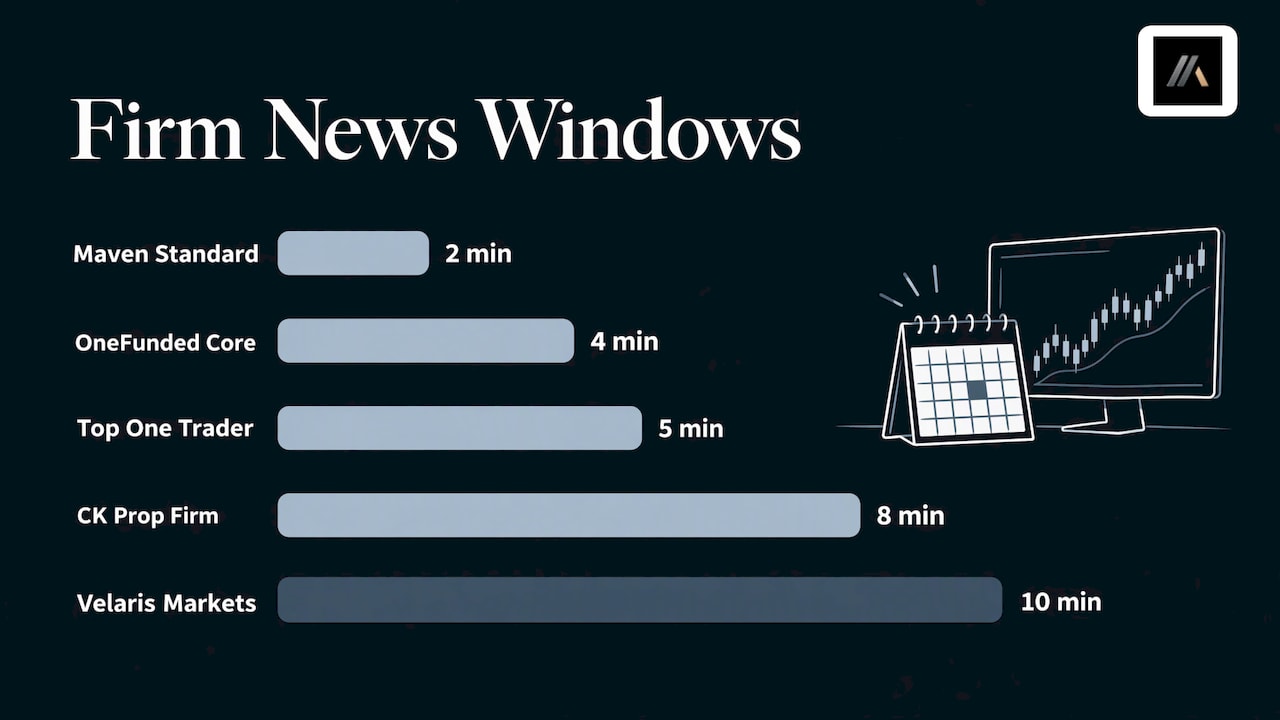
| Top One Trader 2-Step Pro V2 | News trading allowed | Execution restricted 5 minutes before to 5 minutes after high-impact news |
| FundedNext Stellar | Allowed | Allowed, but 40% of profit from qualifying trades within 5 minutes either side counts |
| Maven Trading Standard | Hard breach if you open or close affected instruments within 2 minutes either side | Profits from restricted trades excluded |
| OneFunded Core, Value and Flash | No restriction in evaluation | 4-minute windows either side |
| Velaris Markets | 10 minutes either side on challenge and funded accounts | Same window |
| CK Prop Firm | 8-minute windows on 1 Step Plus, 2 Step Plus and Instant Funding; news trading prohibited on 2 Step Flex | Same |
Notice how much the numbers differ: two, four, five, eight and ten minutes all appear. A habit built on one firm's window can break another firm's rule.
What counts as restricted activity
The details inside the window decide most accidental breaches.
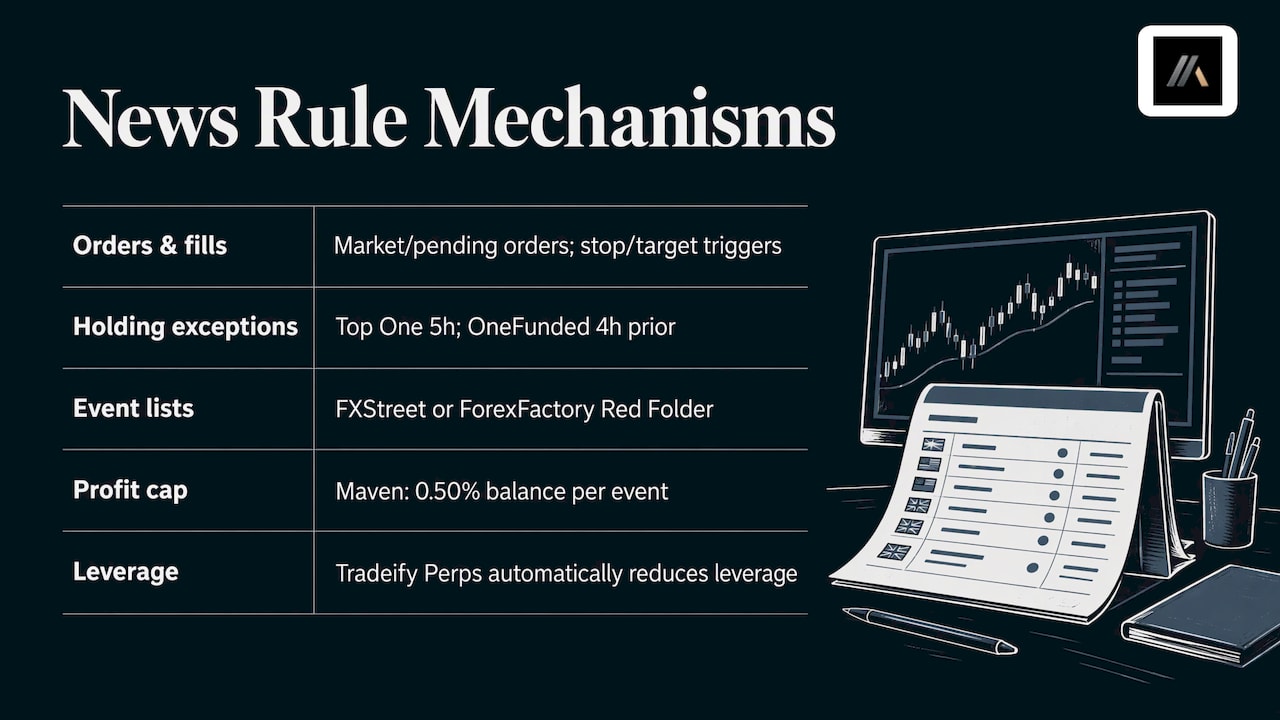
Pending orders and automatic fills. FundedNext's rule covers market and pending orders, including take-profit and stop-loss fills. Hola Prime's page likewise says a stop or target triggered in the window can violate its rules even if the trade was opened earlier.
Holding through the event. Some firms are kinder. Top One Trader says a trade opened at least five hours earlier may have its stop or target trigger in the window, though manual actions stay barred. OneFunded's funded swing exception needs a position opened at least four hours before and does not allow modifications.
Which events count. Firms name their own calendar. Top One Trader uses the FXStreet Economic Calendar, while Maven follows the ForexFactory Red Folder list and its own instrument mapping. A release you do not consider major may still be on a firm's list.
Profit caps. Maven's funded 2-Step OMO allows news trading but caps profit from a single event at 0.50% of the account balance. A different mechanism, same aim: limit what a news spike can earn.
Exposure controls. Tradeify Perps, a futures-style product, reduces leverage automatically instead of imposing a blackout. It is a reminder that not every firm uses a time window.
The same event-risk logic shows up well beyond forex. A look at event-driven trading risks in small-cap stocks shows why catalysts and thin liquidity make execution unpredictable, which is the problem prop firms are trying to contain.
What happens if a rule is broken
Penalties are rarely uniform, and they often escalate:
- Soft breach. Top One Trader says a first violation is generally a soft breach with possible profit deduction or payout impact, and repeats may lead to termination.
- Reduced rewards. Velaris Markets' 13 November 2026 rules give funded accounts 60% rewards after a second risk violation and 40% after a third, and breach the account after the fourth.
- Full profit loss or termination. OneFunded says affected funded trades lose 100% of their profit as a soft breach, while Instant accounts face immediate termination on a confirmed violation.
In general, a firm that decides its rules were broken can refuse a payout, close the account or stop selling challenges to you. That is true whatever the rule says, so the safest habit is to read the firm's current page for your exact product, not a summary of it, including this one.
Doing the homework on any rule
Before buying a challenge, answer five questions from the firm's own help page:
- Is news trading restricted in the challenge phases, the funded phase or both?
- How long is the window, and which calendar defines the events?
- Does the restriction include pending orders and stop-loss or take-profit fills?
- Is the penalty a profit deduction, a soft breach or account closure?
- When was the page last updated, and does it apply to the product you bought?
The last question matters because rules change. Top One Trader's rule, for instance, is dated 5 October 2026 and applies to accounts bought after a stated date. Firms revise windows and exceptions often, so confirm on the day you buy.
How a paired trade deals with news
Here is where Arbitrer fits. Every prop-challenge trade is matched by a smaller, opposite trade on your own broker account. In our worked example, the challenge is $100,000 with a $500 fee, a $500 profit target and a 10% maximum loss. With 1% risk per trade, a 1,000-pip stop and 1:3 reward, the prop trade is 1.00 lot and the broker hedge is 0.12 lot. The hedge is sized with a 0.90 capture ratio for spread and slippage, later replaced by the pair's measured ratio.
A losing trade is about -$1,000 on the prop account and +$108 on the broker. A winning trade is about +$3,000 on the prop account and roughly -$360 on the broker. At the 10% maximum loss, the broker side holds about $1,080: the fee back plus the profit. So if the challenge fails, the broker side has earned back the fee plus a profit target. If the challenge passes, the hedge's loss is carried into the next phase's target, and a funded account's payouts (80% split at the supported firms) are the upside.
Most cycles end with the challenge failing, and that is the plan, not a setback. Be honest about the other side too: if a challenge passes, the broker side is down until a later failed phase or a funded payout recovers it. If a passed account is then closed or a payout refused, the broker loss may not be recovered. Closing a cycle early by hand can lose money. Our paired-trade explainer walks through the full cycle, and the Scenarios planner shows every ending and the broker capital a slot needs before the first trade.
News matters to this routine because both legs depend on clean fills. Around a release, spreads widen and prices jump, so one leg can fill far from the other. These are the protections built into each paired trade:
- Both legs open together, with a 0.11 s average gap between fills and 99.5% within 1 second.
- Fills never match to the cent, because each provider sets its own prices and spreads.
- Every trade gets a stop loss and take profit on both accounts from the moment it opens.
- If a stop or target closes one leg, Arbitrer closes the other.
- Both legs close 1 minute before high-impact news, and trading pauses until 5 minutes after.
- Both legs close 10 minutes before every daily and weekend market close.
- The daily-loss guard stops any trade whose stop would push today's loss past the firm's daily limit, and suggests trading smaller, tightening the stop or waiting for the reset. Our guide to the daily loss limit and to drawdown rules explains the terms.
- Alerts go out by WhatsApp first, then SMS, email and in-app.
These protections are ours. They do not change any firm's rule, and a firm's window may be longer than ours, so your own reading of the rule still comes first.
What Arbitrer does and does not do with firm rules
Every prop firm sets its own rules, and Arbitrer cannot change them. We never claim a firm permits hedging. What we do is enable only well-known firms with a good payout record, and trade each firm to payouts ourselves. If a firm refuses payouts or bans users, we warn users and disable that firm.
The supported prop firms are FTMO 2-Step, FundedNext Stellar 2-Step, Alpha Capital Group Alpha Pro 10%, BrightFunded 2-Step Classic and The5ers High Stakes Classic. The supported brokers are Vantage, VT Markets, PU Prime and Ultima Markets, with more added on request.
Our view
Most traders lose challenge fees because a single trade has to be right, and news is where a single trade is least predictable. We think the sensible response is not to guess the release but to size a second, opposite position so the fee is covered when the challenge fails.
That only works if both sides are managed together and at speed. So we built the news pause, the market-close exits and the daily-loss guard into every pair, and we run each slot on its own server so nothing depends on your laptop staying open.
We are also plain about the limits: trading involves risk of loss, the broker money is real, and a firm's rules are the firm's. Read them first, then let the routine run.
Marius
Setting it up
You pick a prop firm and account size, then a broker, enter two MetaTrader 5 logins and press Launch. Arbitrer rents a trading server (VPS) for each slot with its own fixed IP address used by no one else, installs both MT5 terminals, logs in and checks the right accounts, balances and terminals. It is usually ready in about 30 minutes and always within 12 hours. No trade can open until every check passes. Terminals are watched 24/7 and reconnected remotely if one goes offline, and logins are stored encrypted and deleted 7 days after a pair closes. For the account side, see how to link broker and prop accounts.
Pricing
Our plans are on the pricing page, and a limited-time offer takes $100 off each slot's list price:
- Standard: $199/month (list $299) for 1 slot on 50K accounts, with the first month free and no card.
- Pro: $499/month per slot (list $599) for 50K, 100K and 200K accounts, with signals included.
- Multi-slot: $489 per slot per month for 2-9 slots, and $479 from 10 slots, up to 20.
- Autopilot copy trading: $249 per slot per month ($199 on 2 or more slots).
- Signals alone: $19.99/month.
If you are running several challenges, our guide to managing multiple trading accounts covers keeping them straight.

Work the numbers first: the free calculator at arbitrer.io shows what each ending pays and the broker capital it needs before you spend anything.
FAQ
Do prop firms allow news trading?
It depends on the firm, the product and the phase. Many allow it during the challenge and restrict it on funded accounts, while others restrict both or ban it on certain plans. Read the help page for your exact account before buying.
How long is the news restriction window?
There is no standard. Published windows range from two minutes either side at some firms to ten minutes at others, and the most common in one database was five. Check which calendar the firm uses to define events.
Does a stop loss firing during news break the rules?
At some firms it can. Several firms count stop-loss and take-profit fills as restricted execution, while a few exempt older trades. The firm's own page is the only reliable answer.
What happens to my paired trades around news in Arbitrer?
Both legs close 1 minute before high-impact news and trading pauses until 5 minutes after. This is our protection for the pair and does not change a firm's rules.
Sources
- Top One Trader: 2 Step Pro V2 news trading rule
- FundedNext: Is news trading allowed?
- Maven Trading FAQ
- OneFunded news trading policy
- Velaris Markets trading rules
- CK Prop Firm: high impact news events
- Hola Prime: news trading and weekend position holding
- Tradeify Perps trading rules
- Pipster news trading restrictions database
- Event-driven trading in micro caps
Recommended
- Prop Firm Hedging: How a Paired Challenge Trade Works
- Prop Firm Consistency Rule: How It Works and How to Meet It
- Prop Firm Drawdown Rules: Daily, Maximum, Static and Trailing
- How to Avoid Revenge Trading in Prop Challenges
Trading involves risk of loss; only trade with money you can afford to lose. Results quoted come from Arbitrer's production records and individual customers' completed cycles and do not guarantee future results. Prop firm and broker names belong to their owners, who do not endorse Arbitrer, and each firm's own terms apply. This article is general information, not personal investment advice.